maanantai 19. syyskuuta 2011

Recent sketches for character faces


Update on synopsis

A sailor hunts for the bounty of a mysterious thief, who loots jewels from sailors. The young sailor remembers his past as a boy stealing for a master to survive. On one of his trips he runs into a girl in a pearl diver's shop, who befriends him and gives him an old compass. When the girl's father shows up, the boy is forced to escape. While escaping he drops the compass and falls off a cliff into the sea and is drifted off to a deserted island, where he seeks shelter in a bat cave. In present day we see a man in a cave standing under moonlight and transforming into a bat. The bat loots ships and flies away until he enters the cabin of the pearl diver girl's boat, where he's surprised and recognized by the girl and is forced to escape. The human bat returns to the cave to fight off his curse as a bat. The girl enters the cave and returns the compass to the young sailor, revealing his identity. Thus releasing him from his curse.

Character descriptions

Boy

The boy has grown up as an orphan on the streets where he was forced to steal by an evil master. The master demanded him to steal jewelry. The boy is particularly keen on pearls and their subtle beauty. He would sneak around the pearl diver's shops by the harbor for easy grabs. After an incident he drifted off to an island where he built his own boat and followed his passion for sailing. Until he heard about a thief looting jewels from sailors at sea and decided to catch the thief to gain the handsome reward and solve the mystery of the invisible thief.

Girl

The girl comes from the family of pearl divers. She's lost her mother at an early age and helps her father in diving and keeping their pearl shop. She lives a lonely and quiet life at the sea alongside her father, but finds visitors intriguing for they bring joy and excitement into her life. After her father become ill and unable to work she continues diving alone, venturing further out to the sea.

perjantai 6. toukokuuta 2011

Animation references

I found it difficult to find any animation references on flying bats. So I captured these off a BBC documentary. These images are from bats catching fish China. They are apparently from the first ever footage filmed of bats catching fish!


torstai 5. toukokuuta 2011

Comic influences

European comics are very popular in Finland and there are a number of comic artists, who undoubtedly have had an influence on the style of my animation. In particular artist such as Hugo Pratt, Jean Giraud Moebius, Jean-Claude Mézières and Didier Comés.

Hugo Pratt being the creator of Corto Maltese, one of the best examples of traveller comics representing cultures from around the world, combining history with the life of early 20th century. The simple drawing style of Corto Maltese represents characters and costumes from different ethnicities in a memorable manner. This is the style that Pratt has used for his travel diaries during his numerous voyages from continent to continent. His drawing style is also easily applicable to animation.

The other artist who's influence I find undeniable is Jean Giraud. His visionary style and ideas in French comics since the 60s has been so remarkable that even famous film directors such as Ridley Scott and Luc Besson have invited him to create concepts for their films, such as Alien (1979), The Fifth Element (1997) and Disney's Tron (1982). Also in his later comics he adopted a dreamlike sci-fi style, which uses imaginary transformations to represent the surreal visions in his dreamlike visual stories. In this context I'm interested in his intuitive way of using metamorphosis.

keskiviikko 4. toukokuuta 2011

Sketches on some of the elements

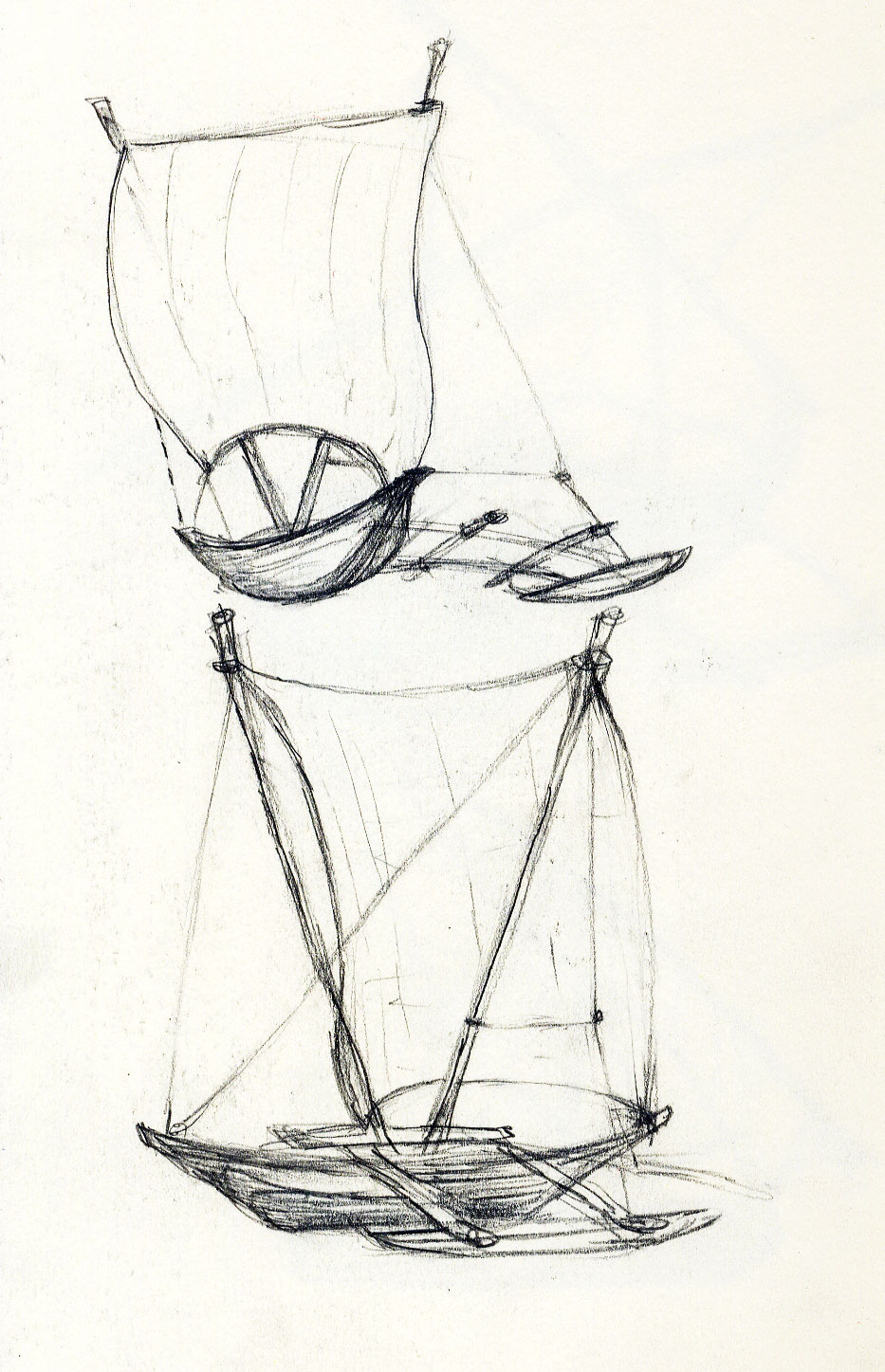
Madagascan boats

Sri Lankan boats

A Flying fox

Useful anatomy for animation on bats.

A flying fox skeleton

More on influences for this animation

Since this animation is taking place in mostly natural environments, I would say that the works of director Terrence Malick has been a significant influence. In particular three of his four films involve natural elements as a significant part of storytelling, although dealing with different subjects that are not directly related to nature. With this style he is able to bring in the natural setting of these films more significantly into the picture, making elements such as water as important as the leading actors in the film. Also in this way he is creating a vivid ambiance to immerse the viewer more deeply into time and surroundings where the film takes place.

These films are: Days of Heaven (1978), which shows the life of the migrant worker in 1920s United States. The Thin Red Line (1999), showing the battle of Guadalcanal island during World War II. The New World (2005), which shows the encounters of British settlers with Native Americans of Virginia in 1607. These films all being period pieces, deal with subjects such as war, conquest and fight over inheritance, which don't seem be directly related to nature. But the director uses shots of the natural surroundings to establish the mood of the period and the effect of nature on humans and vice versa. Above all these films include stunning cinematography of nature with exceptional camera angles and under water photography created without the use of special effects.